

How to Read Tarot for Self-Reflection (Not Fortune Telling)
A quiet, practical guide to reading tarot cards for personal clarity. Learn how to ask open questions, read imagery without a guidebook, and take honest notes.
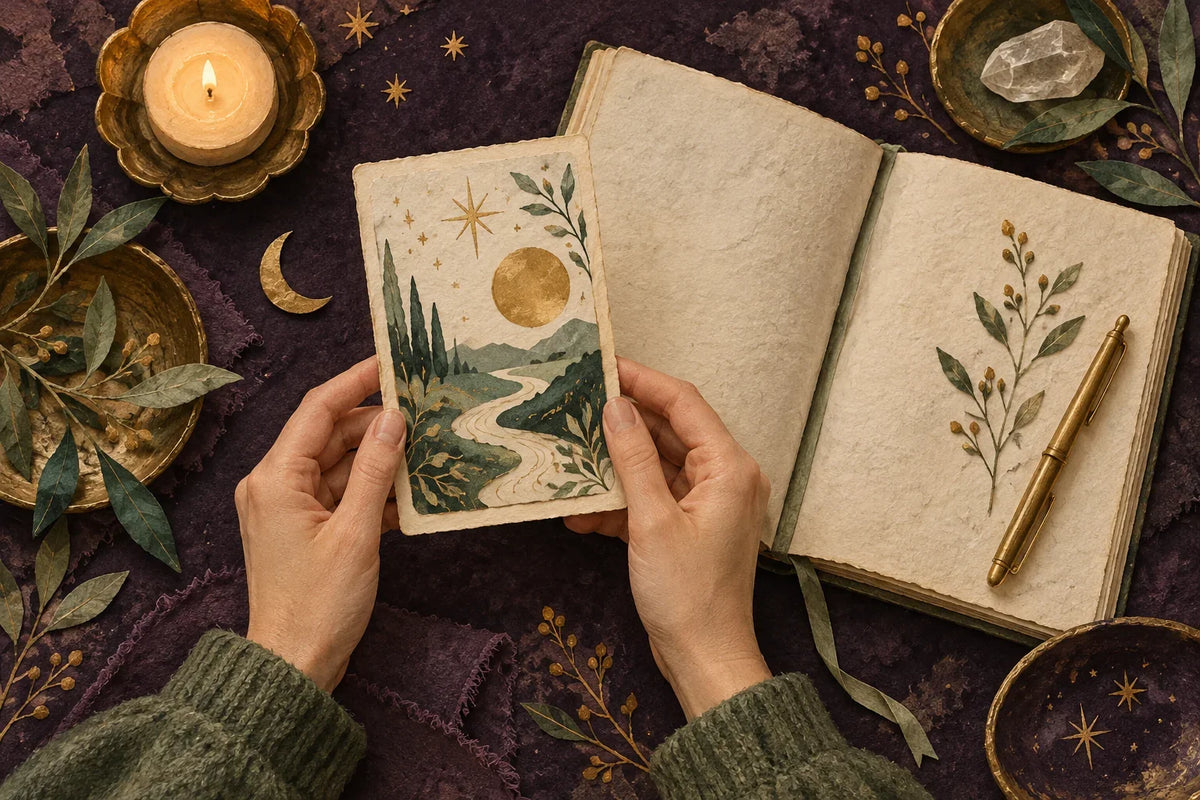
When you sit down with a tarot deck because you feel stuck, it is tempting to ask what is going to happen next. Will a project work out? Will someone get in touch? Did you make a mistake? For generations, popular culture has treated the cards as a fortune-telling device, promising glimpses of a future already written down.
If you treat the cards as a prediction machine, an unwelcome draw usually leads to more shuffling. You pull another card to soften the first one, or you comb through three guidebooks until you find a sentence that reassures you. That habit rarely brings calm. It keeps your attention fixed on a future you cannot control and pulls you away from the choices in front of you.
Learning how to read tarot for self-reflection begins with a different premise. The cards do not know what tomorrow looks like. Instead, they give you seventy-eight visual prompts to help you notice what you are already dealing with today: an unresolved conversation, a boundary you keep putting off, or an assumption you have not questioned.
1. Prediction vs. Reflection: Changing the Question
A predictive question waits for an outcome. A reflective question looks at how you are meeting the situation right now.
Compare how the same dilemma sounds depending on which direction you choose:
- Prediction“Will this relationship work out?”
- Reflection“What need am I hoping this person will meet, and have I stated it plainly?”
- Prediction“Will I get the new job?”
- Reflection“What parts of my current work feel unsustainable, and what am I looking for in the next role?”
- Prediction“Is something going to go wrong?”
- Reflection“What concrete problem am I worried about today, and what can I do about it before Friday?”
- Prediction“Why is this person acting distant?”
- Reflection“How much energy am I spending guessing someone else's mood, and where is my own boundary?”
The first column treats you as someone waiting for news. The second column asks you to look at your own behavior. Tarot cannot tell you what another person thinks on their commute home, but it can help you see where your own energy is leaking.
If you want more examples, our tarot questions guide lists open-ended prompts organized by work, relationships, and everyday decisions.
2. Tarot as a Psychological Mirror (The Jungian Lens)
Tarot works well for journaling because images reach parts of our thinking that words skip past. Carl Jung described archetypes as shared patterns of human experience: the fresh start, the strict rule-maker, the sudden breakdown, the quiet pause. You do not need to study psychoanalysis to recognize them on the table.
When you look at The Fool, you see someone stepping toward an edge without a plan. When you look at The High Priestess, you see someone seated between two pillars, keeping quiet while things develop. When you look at Three of Pentacles, you see three people discussing plans in a stone archway.
A card does not bring new facts into the room. It gives your mind a surface to bounce off.
Two people looking at the same card will notice different details. One person looks at The Hermit and feels lonely; another looks at the same lantern and feels relieved to be left alone. That initial reaction is the useful part of the reading. It tells you what is sitting near the surface of your mind before you have time to edit it.
When you treat each draw as an exercise in self-awareness rather than an omen, the dread disappears. You stop wondering what the card will do to your week, and you start asking what part of your life it brings to mind.
3. The 3-Step Reflective Pull: Pause, Look, Write
If every card pull sends you straight to a booklet, the practice quickly starts to feel like homework. You end up memorizing someone else's keywords instead of paying attention to your own thoughts.
Try this three-step sequence with one card:
Take one minute before shuffling. Clear a small space on the table, put your phone face down, and write down what you are actually dealing with today.
Turn the card over and spend sixty seconds looking at the picture. Notice where your eyes go first: the background color, the posture, or an object in the corner.
Write two sentences connecting that detail to your current situation. What does this picture remind you of in your own week?
Look closer: Two of Swords
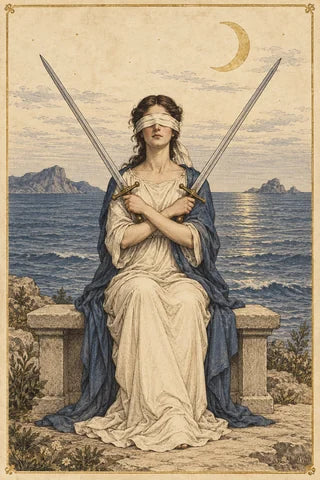
Here is an example from practice. You feel conflicted about whether to take on an extra client project. You pull the Two of Swords.
Notice
Instead, look at the figure: she sits with two heavy blades crossed over her chest, a blindfold over her eyes, and calm water behind her. Her arms look tired from holding those swords up. You ask yourself:
Reflect
A fortune-telling book might say: “A stalemate or an impossible decision.” That does not help you move forward.
The card does not tell you whether to sign the contract. It shows you that you are exhausted from stalling, and that the tension comes from avoiding an awkward email.
Write
- Where am I keeping my eyes closed because making a decision means telling someone no?
- If the water behind me is calm, why am I holding these weapons so tightly?
4. Feared Cards: Death, The Tower, and Ten of Swords
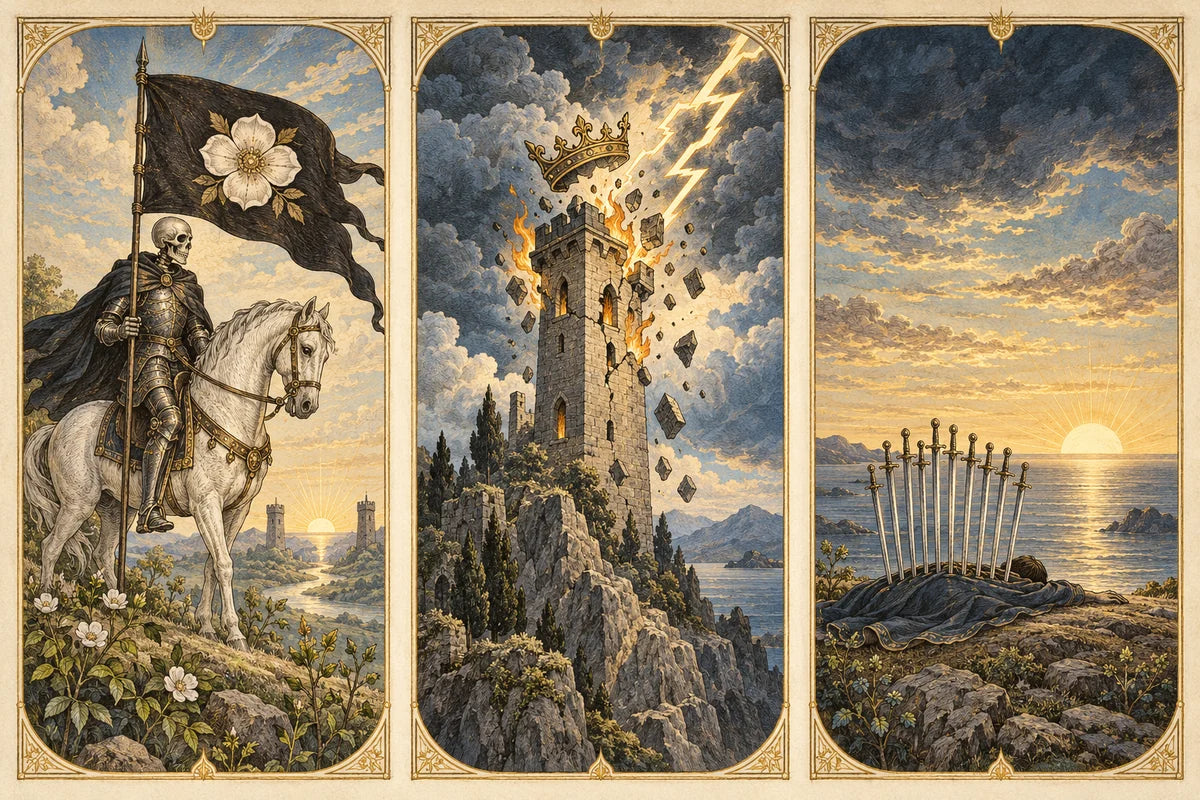
A few cards in the deck have an alarming reputation because historical decks used dramatic imagery to catch the eye. When you read for self-reflection, these cards point to ordinary transitions that feel uncomfortable.
Death (XIII): Ending a Phase
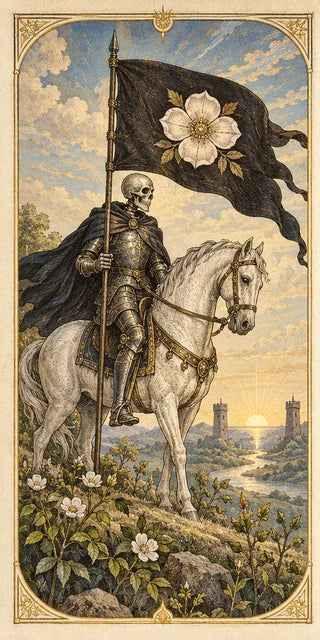
In daily life, things finish all the time: a project wraps up, a habit stops working, or an old goal no longer interests you. Death marks that point of completion. It asks a straightforward question: What are you holding onto simply because it feels familiar, even though it has nothing left to give you?
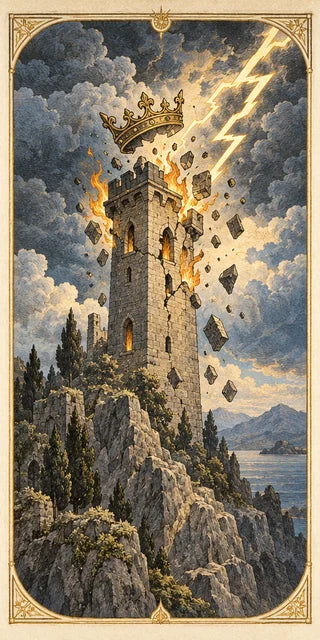
The Tower (XVI): When Plans Fall Apart
The picture shows a building struck by lightning. In personal terms, The Tower reflects the moment an assumption turns out to be wrong. A budget does not hold, a partner admits they are unhappy, or a plan you relied on falls through. It is disorienting, but it also ends the effort of defending an illusion. You get to rebuild on what is actually true.
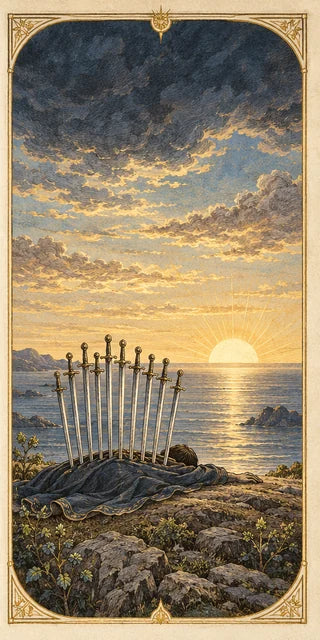
Ten of Swords: The End of an Overthinking Loop
The image looks grim: ten swords in a figure on the ground. But look at the horizon behind the rocks: the dark clouds are breaking, and pale yellow light is showing across the water. The Ten of Swords usually appears when you have replayed a worry until your brain is raw. The swords are your own thoughts, and there are no more swords left in the suit. The crisis has peaked. You can put the problem down for the night.
Our card meanings library covers all seventy-eight cards with visual notes and reflection questions, written without fortune-telling jargon.
5. Five Daily Journal Prompts for Real Clarity
You do not need a ten-card layout to get useful notes. One card pulled in the morning with a concrete question will give you more to work with than a table covered in spreads you cannot remember.
Try writing one of these prompts beside your card:
- Where did I see this card's attitude in my conversations yesterday?
- What detail in this image irritates or bores me, and what does that say about what I am avoiding?
- If this figure had to set one boundary before lunch today, what would it be?
- What quiet quality here do I need to borrow for a meeting or conversation coming up?
- What is one small, manageable action this card suggests for this afternoon?
Keep the entry to three or four lines. Write about things you can verify: who you spoke to, what you ate, what made you tired. A good journal entry sounds like an ordinary note to yourself, not a prophecy.
6. Keeping a Quiet, Sustainable Routine
You do not need special equipment, crystals, or an hour of free time. A quiet table, comfortable morning light, and five minutes before opening your inbox are enough.
The physical feel of the cards does make a difference to attention. Shuffling a sturdy, well-weighted deck, like the 400gsm coated cardstock we use for the Celestial Tarot, gives your hands something rhythmic and tactile to do, which helps your shoulders drop before you begin writing.
When you want to look at a situation with more than one card, stick to simple three-card frameworks. Our guide to tarot spreads shows how to lay out three cards for situation, challenge, and practical next step. If you are working through a heavier crossroads where your own blind spots make it hard to see clearly, our Three-Card Written Reading delivers a thorough, human-written analysis in a quiet PDF you can keep.
Put your cards away when you are done. The goal is not to stay in a reading all morning, but to take one useful observation back into your day.
Written by Mira Lin for The Fool’s Journal. If you are beginning your reflective journey, explore our guide to framing clear tarot questions or review what to do after your reading.
YOUR NEXT STEP
Where will your curiosity take you?Choose your next step

FREE PRACTICE
A moment for reflectionFree card reading
Draw a card and make space for today’s reflection.One card. A little reflection.
Draw a daily card
FIND YOUR DECK
A deck for your practiceFind your tarot deck
Explore tarot decks for your daily ritual.A deck for your daily ritual.
Explore tarot decksExplore decks
PERSONAL READING
Explore your questionA reading by Mira Lin
A personal written reading by Mira Lin.Personal written guidance.
Digital PDF
View personal readingsView readings